The Name: A Bay Filled with Earth
The name "Dolmabahçe" literally means "filled garden" in Turkish — from dolma (filled) and bahçe (garden). The site was originally a small bay along the Bosphorus used as a natural harbor for the Ottoman naval fleet. Beginning in the 17th century under Sultan Ahmed I, the bay was gradually filled in with earth and rubble to create dry land, which was then laid out as imperial gardens.
For over two centuries before the palace was built, this filled-in bay served as a private garden and recreational area for the sultans. Several wooden kiosks and pavilions stood on the grounds, making it one of the most pleasant spots along the Bosphorus shore. But it was not until the 1840s that a sultan would conceive the audacious plan to build a massive stone palace on this reclaimed land.
The Ottoman Empire in the 1840s: Context for a New Palace
To understand why Dolmabahçe was built, one must understand the state of the Ottoman Empire in the mid-19th century. The empire was in the grip of the Tanzimat ("Reorganization") — a sweeping period of reform launched in 1839 that sought to modernize Ottoman institutions along European lines. The Tanzimat touched everything: law, education, the military, taxation, and civil rights for non-Muslim minorities.
Sultan Abdülmecid I, who ascended to the throne in 1839 at just sixteen years old, was the architect of the Tanzimat reforms. Young, European-educated in his sensibilities, and acutely aware that the Ottoman Empire was falling behind the industrializing nations of Europe, Abdülmecid saw architecture as a tool of statecraft. A modern palace would send a message to European powers: the Ottomans were not a declining medieval empire but a modernizing state worthy of respect.
Topkapı Palace, which had served as the seat of government since 1465, was seen as part of the problem. Built as a sprawling complex of pavilions and courtyards in the classic Ottoman style, Topkapı lacked the grand ceremonial halls that European diplomacy required. It had no ballroom. Its rooms were small by European standards. Its plumbing and heating were antiquated. For a sultan hosting European ambassadors who had grown accustomed to Versailles and Schönbrunn, Topkapı was an embarrassment.
Construction: 1843–1856
The Balyan Dynasty of Architects
Sultan Abdülmecid entrusted the design to the Balyan family, a dynasty of Armenian-Ottoman architects who had served the sultans for generations. The lead architects were:
- Garabet Amira Balyan (1800–1866) — The patriarch and chief architect
- Nigoğayos Balyan (1826–1858) — Garabet's son, who had studied at the Académie des Beaux-Arts in Paris
The Balyans were uniquely suited to the task. They understood both Ottoman building traditions and European architectural styles. Nigoğayos, in particular, brought firsthand knowledge of French Baroque and Neoclassical design from his studies in Paris.
Design Philosophy
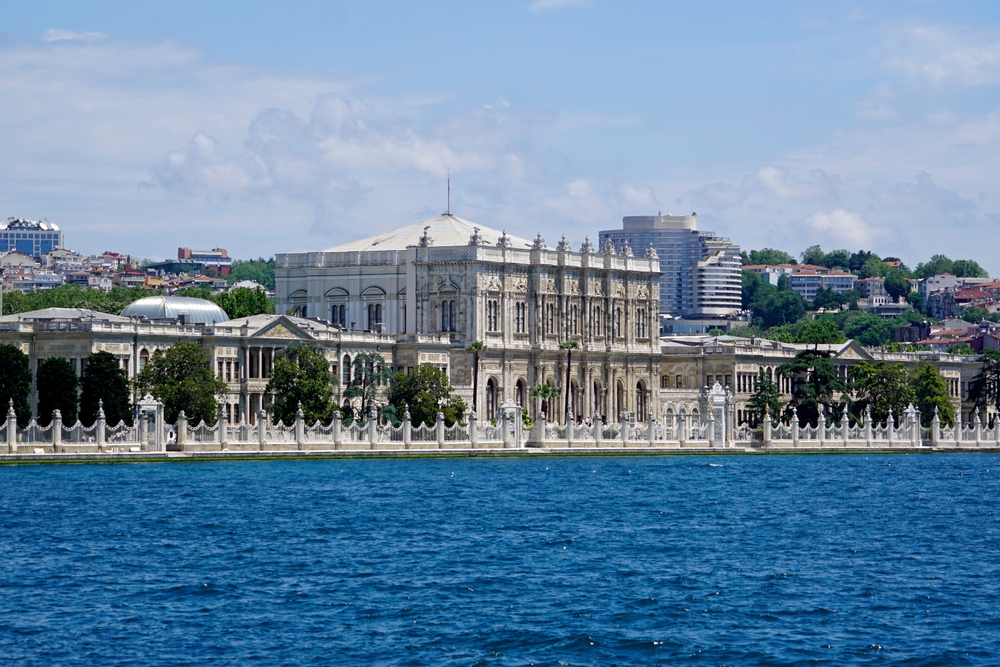
The palace was conceived as a single monumental structure — a radical departure from the pavilion-based layout of Topkapı. The Balyans designed a 600-meter-long waterfront facade facing the Bosphorus, organized around three main sections:
- Selamlık (Mabeyn-i Hümayun) — The ceremonial and administrative wing on the south
- Ceremonial Hall (Muayede Salonu) — The monumental central hall connecting the two wings
- Harem-i Hümayun — The private family quarters on the north
This tripartite plan echoed European palace design (public wing – central hall – private wing) while maintaining the Ottoman tradition of separating public and private space.
Materials and Craftsmanship
The construction consumed extraordinary quantities of precious materials:
- 14 tonnes of gold leaf for ceiling and wall decoration
- 40 tonnes of silver for furnishings and fittings
- Marmara marble for the exterior facade
- Egyptian alabaster for the baths
- Baccarat crystal from France for the Crystal Staircase
- Bohemian crystal from the Czech lands for chandeliers
- Hereke carpets — custom-woven at the imperial workshops
- Silk curtains from Lyon, France
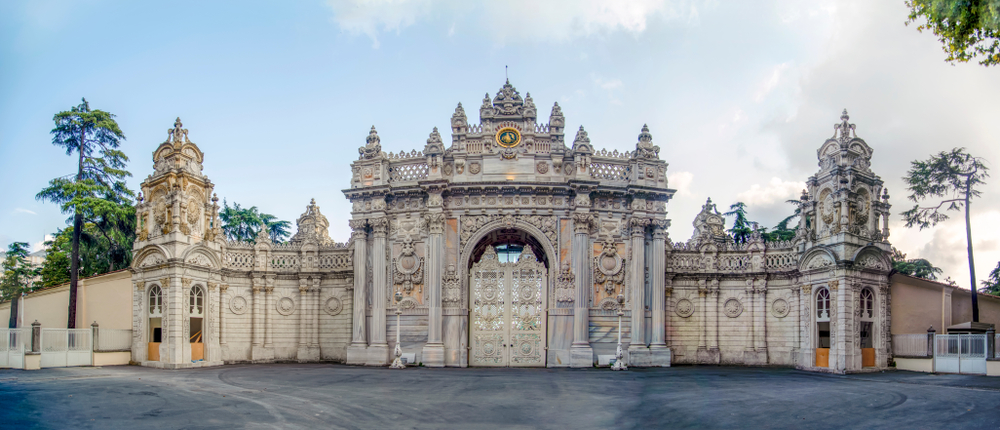
Teams of European and Ottoman craftsmen worked side by side. French decorators painted ceiling frescoes. Italian stonemasons carved the marble facades. Ottoman calligraphers added Arabic inscriptions. The result was a building that belonged to no single tradition — it was genuinely hybrid.
The Cost
The final cost was staggering: approximately 5 million Ottoman gold liras, equivalent to roughly 35 tonnes of gold. This represented about one-quarter of the empire's annual tax revenue. Critics within the Ottoman government argued that the expenditure was reckless for an empire already struggling financially. History would prove them at least partially right — the debt incurred for Dolmabahçe and other grand construction projects contributed to the Ottoman bankruptcy of 1875.
The Sultans of Dolmabahçe
Abdülmecid I (reigned 1839–1861)
Abdülmecid moved into the palace upon its completion in 1856 and lived there until his death from tuberculosis in 1861, at the age of 38. He was the first sultan to host a European-style ball in the Ceremonial Hall and used the palace to receive ambassadors and visiting heads of state. His commitment to modernization was genuine — he also built the first Ottoman telegraph line and opened the first modern universities.
Abdülaziz (reigned 1861–1876)
Abdülmecid's brother and successor was even more extravagant. Abdülaziz added new furnishings, commissioned more paintings (including works by Ivan Aivazovsky, the Russian-Armenian marine painter), and continued the palace's lavish lifestyle. His spending habits contributed to the fiscal crisis that led to his deposition in 1876. He was found dead in the palace days after his deposition — officially a suicide, though many historians suspect murder.
Murad V (reigned 1876, 93 days)
Murad V, Abdülaziz's nephew, reigned for only 93 days before being deposed due to mental instability. He spent most of his brief reign at Dolmabahçe.
Abdülhamid II (reigned 1876–1909)
The most consequential sultan to use Dolmabahçe, Abdülhamid II initially lived in the palace but moved to Yıldız Palace in 1880. Paranoid about assassination attempts, Abdülhamid found the exposed Bosphorus-front location of Dolmabahçe a security nightmare. He preferred the hilltop seclusion of Yıldız, where he could control access more easily. For nearly three decades, Dolmabahçe stood largely unused.
Mehmed V (reigned 1909–1918)
After the Young Turk Revolution of 1908 and Abdülhamid's deposition in 1909, the new puppet sultan Mehmed V returned to Dolmabahçe. By this time, however, real power lay with the Committee of Union and Progress (CUP). The palace served as a ceremonial backdrop rather than a center of power.
Mehmed VI (reigned 1918–1922)
The last Ottoman sultan, Mehmed VI, lived at Dolmabahçe until November 17, 1922, when he fled Istanbul aboard the British warship HMS Malaya. He left through the back gate of the palace under cover of darkness — a quietly dramatic end to 469 years of Ottoman rule in Istanbul.
The Republic Era: 1923–Present
Atatürk at Dolmabahçe (1927–1938)
After the establishment of the Turkish Republic in 1923, Dolmabahçe Palace was transferred to the national patrimony. Mustafa Kemal Atatürk, who primarily governed from Ankara, used Dolmabahçe as his Istanbul residence and workplace from 1927 onward.
Atatürk conducted important state business from the palace, received foreign dignitaries, and worked on his reform programs. He occupied a relatively modest suite in the Harem section — Room 71 — which contrasted sharply with the ornate state rooms.
On November 10, 1938, Atatürk died in Room 71 at 09:05 in the morning, succumbing to cirrhosis of the liver at the age of 57. Every clock in the palace was stopped at 09:05 — a tradition that continues to this day. Each year on the anniversary, the palace holds a solemn commemoration, and hundreds of thousands of visitors come to pay their respects.
Becoming a Museum
After Atatürk's death, Dolmabahçe served as a venue for state ceremonies and hosted visiting heads of state. In 1984, the palace was opened to the public as a museum under the administration of the Turkish Grand National Assembly. Today it operates under the Milli Saraylar (National Palaces) administration.
The palace underwent major restorations in the 1990s and 2000s to repair water damage, structural issues, and deterioration of decorative elements. Conservation work continues today, using traditional techniques to preserve the original materials wherever possible.
Timeline of Key Events
| Year | Event |
|---|---|
| 1600s | Bay filled in, imperial gardens created |
| 1843 | Construction begins under Sultan Abdülmecid I |
| 1856 | Palace completed; Sultan moves in |
| 1861 | Abdülmecid I dies at the palace |
| 1876 | Sultan Abdülaziz deposed and dies at Dolmabahçe |
| 1880 | Abdülhamid II abandons Dolmabahçe for Yıldız Palace |
| 1890–1895 | Clock Tower built |
| 1909 | Mehmed V returns to Dolmabahçe after Young Turk Revolution |
| 1922 | Last sultan Mehmed VI flees via the palace |
| 1924 | Palace transferred to Turkish Grand National Assembly |
| 1927 | Atatürk begins using palace as Istanbul residence |
| 1938 | Atatürk dies at 09:05 on November 10 |
| 1984 | Palace opens to public as museum |
| 2007–2012 | Major restoration campaign |
| 2019 | Administration transferred to Milli Saraylar |
The Palace Today
Dolmabahçe Palace receives approximately 2.5 million visitors annually, making it one of the most visited sites in Istanbul. The museum experience is divided into two main tour circuits (Selamlık and Harem), with additional areas including the Clock Tower, the Painting Museum, the Mosque, and the palace gardens.
The palace remains a symbol of both Ottoman grandeur and Turkish national identity. For visitors, it offers something that no other palace in Istanbul can: the tangible intersection of two eras — the twilight of empire and the dawn of a republic — all set against the stunning backdrop of the Bosphorus.